Conductivity is an important water-quality measurement in boiler systems because it helps operators track changes in dissolved ionic material. When conductivity rises above the established operating limit, it can signal that boiler water chemistry is moving outside the desired control range. Understanding why conductivity increases helps protect steam quality, heat-transfer surfaces, and boiler equipment. This article explains the main causes and effects of high conductivity in boiler water, recommended conductivity ranges, and practical ways to monitor and maintain safe levels.
What Is Conductivity in Boiler Water?
Conductivity measures how easily water carries an electrical current. In boiler water, dissolved ions such as sodium, chloride, sulfate, hydroxide, and other charged substances affect the measurement. In general, the more dissolved ions present, the higher the conductivity. Conductivity is commonly reported in microsiemens per centimeter (µS/cm) or millisiemens per centimeter (mS/cm). Conductivity often serves as an indirect indicator of total dissolved solids, or TDS, but the two are not identical. Different dissolved substances conduct electricity differently, so there is no universal conductivity-to-TDS conversion factor for every boiler water chemistry.
What Causes High Conductivity in Boiler Water?
Several operating and water-quality conditions can cause conductivity to rise.
Concentration During Steam Generation
As a boiler produces steam, most nonvolatile dissolved substances remain in the boiler water. Hence, their concentration increases as more water is converted to steam.
Blowdown removes some of this concentrated water and replaces it with treated feedwater. If the blowdown rate is too low for the boiler’s operating conditions, dissolved material can continue to accumulate and conductivity can rise above the desired limit.
Changes in Makeup Water or Feedwater Quality
Boiler conductivity can also increase when more dissolved ionic material enters with the feedwater. This may happen when upstream treatment equipment is not performing as expected. Potential causes include declining reverse-osmosis performance, exhausted ion-exchange media, softener problems, or changes in the incoming water source.
Contaminated Condensate Return
Condensate is often returned to a boiler because it retains useful heat and can reduce makeup-water requirements. However, condensate can become contaminated by process leaks, heat-exchanger failures, or contact with other process fluids. If contaminated condensate is returned to the system, it can increase the ionic load entering the boiler and raise conductivity.
Changes in Water Treatment Chemicals
Boiler treatment chemicals can also affect conductivity because many contain ionic compounds. A change in chemical feed rate may therefore change conductivity even when feedwater quality remains stable. For this reason, evaluate conductivity in the context of the overall water treatment program rather than as a stand-alone measurement.
Temperature or Measurement Problems
An unusually high reading does not always mean the water chemistry has changed. Conductivity varies with temperature, so appropriate temperature compensation is important. Sensor fouling, calibration drift, improper installation, or inconsistent sampling can also produce misleading readings.
What Are the Effects of High Conductivity in Boiler Water?
High conductivity is an indicator, not a contaminant itself. Its significance depends on which dissolved substances are present and whether other boiler water parameters are also outside their control limits.
Foaming and Carryover
High concentrations of dissolved and suspended material can increase the potential for foaming. Foaming can allow droplets of boiler water to leave with the steam, a condition known as carryover. Carryover reduces steam purity and can transport unwanted material into downstream steam lines, valves, heat exchangers, and turbines.
Scale and Deposits
Some dissolved substances can form deposits on boiler heat-transfer surfaces when water chemistry is not properly controlled. Scale creates an insulating layer between the heated metal surface and the boiler water. This can reduce heat-transfer efficiency and increase thermal stress on boiler components.
Increased Risk to Boiler Equipment
Abnormal conductivity can also be an early indication that boiler water chemistry has changed in a way that may affect equipment reliability. Conductivity alone does not measure corrosion or identify a specific contaminant. Other factors such as dissolved oxygen, pH, alkalinity, chlorides, temperature, and treatment chemistry must also be considered.
What Is the Recommended Conductivity Range for Boiler Water?
No single recommended conductivity range applies to every boiler.
The correct limit depends on factors such as boiler design, operating pressure, steam-purity requirements, feedwater quality, treatment chemistry, and downstream steam use.
In general, higher-pressure boilers require tighter control of boiler water chemistry than many lower-pressure systems. ASME-based guidance illustrates this difference. For example, some lower-pressure industrial boilers operating from 0 to 300 psig may allow specific conductance below about 7,000 µS/cm. In contrast, certain higher-pressure water-tube boilers may require values of 150 µS/cm or less. These values are reference points, not universal setpoints. Each facility should establish its operating range based on boiler manufacturer recommendations, applicable industry guidance, steam-quality requirements, and the water treatment program.
How Is Boiler Water Conductivity Monitored?
Conductivity can be measured at several points in a boiler system, including:
- Makeup water
- Treated water
- Feedwater
- Boiler water or continuous blowdown
- Condensate return
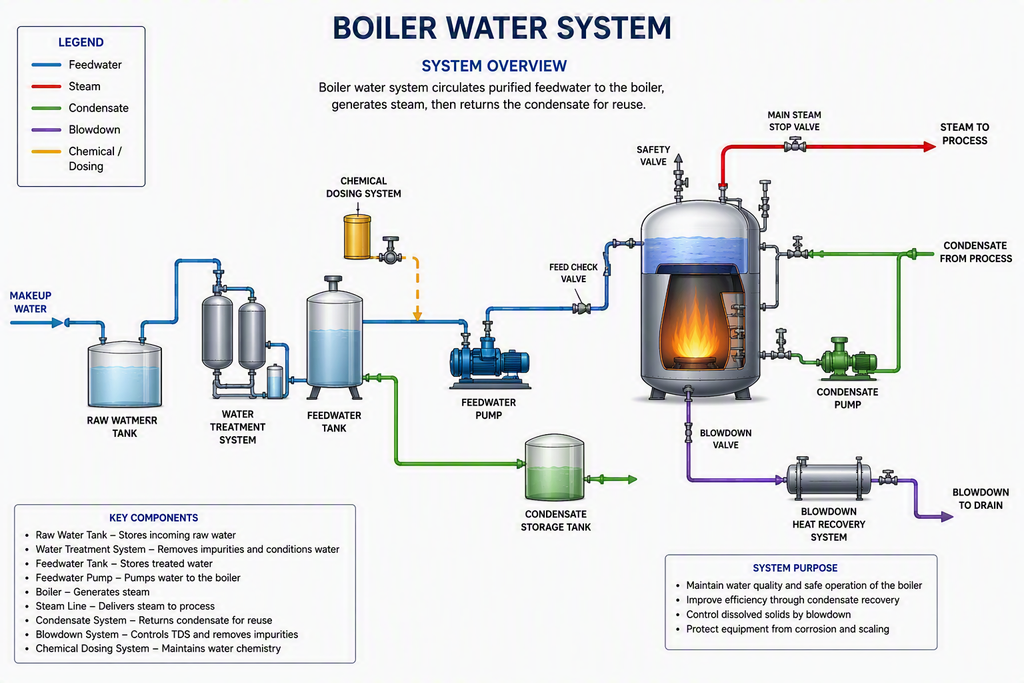
Each location provides different information. Upstream measurements help verify the quality of water entering the boiler, while boiler water measurements show how much ionic material is concentrating inside the system. Conductivity may be checked through manual sampling or measured continuously with an inline conductivity sensor connected to an analyzer, transmitter, or control system. Continuous monitoring is especially useful when operating load or water quality changes frequently because it allows operators to recognize deviations quickly.
How to Maintain Safe Boiler Water Conductivity Levels
Maintaining conductivity within the established operating range requires both reliable measurement and appropriate process control.
Establish the Correct Limit
Start with a conductivity range that reflects the specific boiler, operating pressure, steam requirements, and treatment program rather than relying on a generic target.
Verify Unexpected Readings
Before making major process changes, confirm that the measurement is reliable. Check sensor condition, temperature compensation, analyzer settings, calibration, and sampling practices as appropriate.
Adjust Blowdown When Needed
If conductivity is elevated because dissolved material has become too concentrated, adjust blowdown according to the facility’s operating procedures and treatment program.
The goal is to control concentration without removing more heated water than necessary.
Investigate Persistent Changes
If conductivity remains outside the established range, investigate the source. Review feedwater treatment, condensate return, chemical dosing, and measurement performance to determine what changed.
Tracking conductivity trends over time can also help operators identify gradual shifts and compare readings with boiler load or treatment adjustments.

Conductivity Measurement Solutions From AlpHa Measurement Solutions
Reliable boiler water management depends on measurement technology suited to the application’s conductivity range, temperature, installation method, and process conditions.
AlpHa Measurement Solutions develops and manufactures standard and customizable conductivity sensing technologies for industrial liquid analysis and power-generation applications. Its portfolio includes contacting two-, three-, and four-cell technologies as well as toroidal conductivity sensing.
Depending on the configuration, AlpHa conductivity solutions can support:
- Conductivity ranges from approximately 0.055 µS/cm to 1,000 mS/cm.
- Temperature capabilities from approximately -5°C to 200°C.
- Multiple cell constants of 0.01, 0.1, 1, and 10 for two-, three-, and four-cell electrodes.
- Continuous process-monitoring configurations.
- Configurable housing materials.
- Custom mechanical assemblies.
- Integration with compatible analytical instrumentation.
Because conductivity applications vary widely, select sensors based on actual process conditions rather than a one-size-fits-all configuration. Contact AlpHa Measurement Solutions to discuss conductivity sensing requirements for boiler water, power generation, or other industrial liquid-analysis applications.
Frequently Asked Questions About Boiler Water Conductivity
Potentially. An unexpectedly low reading may indicate excessive blowdown, a change in the treatment chemical concentration, unusually low ionic content in the incoming water, or a measurement issue. Compare the reading with the boiler’s established operating range.
Conductivity is commonly reported in microsiemens per centimeter (µS/cm) or millisiemens per centimeter (mS/cm). One millisiemens per centimeter equals 1,000 microsiemens per centimeter.
The cell constant describes the geometry of a contacting conductivity sensor and helps determine the conductivity range the sensor is best suited to measure. Different cell constants are used for different conductivity levels.
Not always. Very low-conductivity water and highly conductive process water may require different sensor configurations, cell constants, or measurement technologies. Sensor selection should account for the full expected conductivity range.
Maintenance depends on the sensor design and process conditions. Operators should follow the manufacturer’s recommendations for inspection, cleaning, calibration or verification, storage, and replacement.