Water quality professionals increasingly rely on fluorescence-based monitoring to detect contamination that traditional parameters often miss. While turbidity, conductivity, and pH provide valuable context, they do not always reveal the source or nature of organic pollution. Fluorescence sensors fill this gap by targeting specific compounds that act as indicators of human activity or biological processes. Two of the most common fluorescence indicators are optical brighteners and tryptophan. Although both rely on fluorescence principles, they measure very different aspects of water quality. This article explains what optical brighteners and tryptophan fluorescence measure, how they behave in natural and engineered water systems, and why measuring both parameters provides a more complete picture of pollution.
Fundamentals of Fluorescence in Water Monitoring
Fluorescence occurs when a compound absorbs light at one wavelength and emits light at a longer wavelength. This occurs in many organic molecules, thus enabling sensors to detect compounds at very low concentrations, often in parts per billion. Unlike laboratory methods that require sample collection and preparation, fluorescence sensors operate continuously in the field. Also, they provide near-instant feedback, a critical feature for early detection of contamination events. As a result, utilities and environmental agencies increasingly use fluorescence to supplement traditional grab sampling.
However, not all fluorescent compounds tell the same story. The excitation and emission wavelengths selected by a sensor determine which compounds it detects. This distinction becomes especially important when comparing optical brighteners and tryptophan.
What Are Optical Brighteners
Optical brighteners, or fluorescent whitening agents, are synthetic chemicals added to detergents, paper products, textiles, and plastics. Their purpose is to absorb ultraviolet light and re-emit blue light, making materials appear brighter and cleaner to the human eye. Because optical brighteners originate almost exclusively from human activity, they serve as strong indicators of wastewater contamination. They enter water systems through domestic sewage, industrial effluent, and stormwater runoff, which carry detergents and household waste into surface waters. Importantly, optical brighteners are not naturally abundant in pristine environments. Therefore, when sensors detect them in rivers, streams, or groundwater, the signal often points directly to human influence.
What Is Tryptophan Fluorescence
Tryptophan is an amino acid found in proteins and is present in living organisms, bacteria, algae, and decaying organic matter. Unlike optical brighteners, tryptophan can originate from both natural and anthropogenic sources. It may enter water systems through wastewater, agricultural runoff, decaying vegetation, or algal growth. As a result, tryptophan fluorescence often correlates with biological oxygen demand, microbial contamination, and nutrient-driven ecosystem changes. Because tryptophan responds quickly to changes in biological activity, it serves as an effective early-warning parameter. Sudden increases may indicate sewage intrusion, nutrient loading, or microbial blooms that could affect treatment performance or ecosystem health.
Key Differences Between Optical Brighteners and Tryptophan
Although both parameters rely on fluorescence, their interpretation differs significantly.
Optical brighteners primarily signal human-derived contamination. Their presence strongly suggests the influence of wastewater, detergent discharge, or urban runoff. In contrast, tryptophan reflects biological activity and organic matter that may originate from natural or human sources.
Another key difference lies in persistence. Optical brighteners tend to degrade slowly under natural conditions, especially in low-light environments. This persistence allows them to travel long distances downstream, making them useful for tracing contamination sources. Tryptophan, on the other hand, is more dynamic. Its concentration can change rapidly as microbial populations grow or decline.
Because of these differences, relying on only one parameter can lead to incomplete conclusions. A rise in tryptophan alone may reflect natural biological processes, while optical brighteners confirm whether human activity plays a role.
Why Combining Both Parameters Improves Water Quality Insight
When used together, optical brighteners and tryptophan fluorescence provide a powerful diagnostic framework. Optical brighteners identify anthropogenic influence, while tryptophan reveals the biological response to that influence. For example, elevated tryptophan without optical brighteners may indicate natural organic loading, such as leaf litter or algal growth. However, elevated levels of both parameters strongly suggest wastewater contamination with active microbial content. This distinction helps operators prioritize responses and allocate resources more effectively.
In surface water monitoring, optical brighteners help identify sewage intrusion in rivers and streams, while tryptophan tracks microbial loading after storm events. While in groundwater, optical brighteners can reveal leakage from septic systems or sewer lines that traditional parameters might miss.
Tryptophan in drinking water treatment serves as a surrogate for organic loading that may lead to disinfection byproduct formation. Optical brighteners help utilities assess upstream wastewater influence that could compromise source water quality.
In wastewater treatment, both parameters support process optimization and compliance monitoring. Continuous fluorescence data allows operators to respond quickly to changing influent conditions.
AlpHa Optical Brighteners Fluorometer: Targeted Detection of Anthropogenic Pollution
AlpHa’s Optical Brighteners Fluorometer is purpose-built to detect fluorescent whitening agents in water with high precision and stability. The sensor uses continuous excitation techniques and a unique optical configuration to deliver consistent and reliable measurements across its operational range.
Our optical design and signal acquisition system ensure excellent linearity and long-term stability, which is critical for trend analysis and regulatory monitoring. An integrated temperature sensor provides automatic temperature compensation, while user-input turbidity correction improves accuracy in waters affected by sediment or runoff. Designed for field deployment, the probe features a rugged outer construction made from titanium alloy, special glass, and chemically resistant polymers. This construction allows the sensor to operate reliably in organic, inorganic, and corrosive water environments. Its compact size also makes it easy to integrate into multiparameter sondes, including the AlpHa Sonde, or install as a standalone probe.
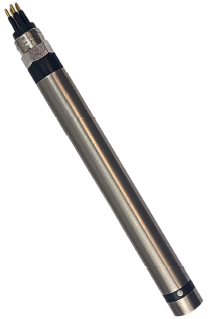
From a connectivity standpoint, our optical brighteners fluorometer operates on a wide 5 to 36 V DC input and delivers a 0 to 3 V analog output compatible with most data acquisition platforms. In addition, the wired UART Modbus interface supports digital communication for modern monitoring systems. Together, these features make AlpHa’s Optical Brighteners Fluorometer an ideal tool for wastewater tracing, stormwater monitoring, source water protection, and environmental compliance programs.
AlpHa Tryptophan Sensor: High-Sensitivity Insight into Biological Organic Matter
AlpHa Measurement Solutions brings advanced optical sensing to biological monitoring with the XC-TRYP Tryptophan Fluorometer. Designed for both standalone use and integration into multiparameter sondes, this sensor delivers lab-grade sensitivity in a rugged, field-ready format.
One of its defining strengths is an ultra-low detection limit below 2 ppb, which makes it well-suited for clean water applications and early detection scenarios. At the same time, the wide measurement range of 0 to 5,000 ppb allows the sensor to perform reliably in more challenging environments such as wastewater influent or nutrient-rich surface waters.

The XC-TRYP responds quickly, with a typical response time of about 10 seconds. This fast feedback enables operators to detect changes in organic loading in near real time. Integrated temperature compensation ensures accurate readings across a temperature range of 0 to 50 degrees Celsius. Built for demanding installations, the sensor carries a maximum pressure rating of 375 meters, making it suitable for deep or pressurized systems. Flexible output options include analog 0 to 3 V with UART Modbus and digital RS-485 MODBUS RTU, supporting seamless integration with SCADA and data logging platforms. In addition, Bluetooth-ready functionality allows pairing with AlpHa’s XCITE Measure App for real-time visualization, data logging, and export. Combined with customizable housings, connectors, and form factors, the XC-TRYP offers exceptional flexibility for utilities, researchers, and system integrators.