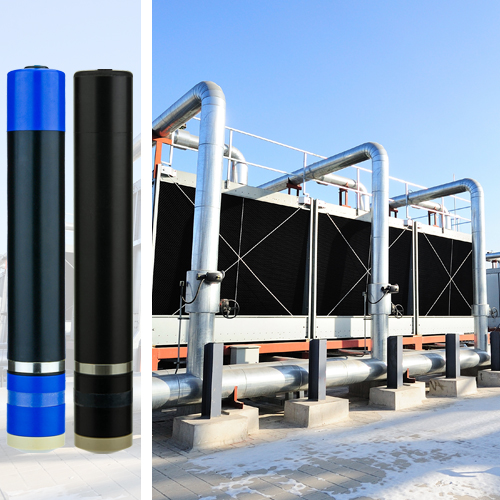
At Alpha, our free & total chlorine sensors are specifically designed for power generation applications, providing robust, accurate, and customizable solutions. Our sensors feature:
Robust Design: Constructed from durable materials like PVC, CPVC, ABS, and Ryton.
High Accuracy and Resolution: Accuracy of 0.2 ppm or 4%, as well as a resolution of 0.01 ppm.
Wide Measurement Range: Adjustable from 0-2 ppm to 0-100 ppm.
Optimized Flow Rate: Functions efficiently with flow rates between 30 L/hr and 60 L/hr.
Integrated Temperature Compensation: Ensures consistent performance across 0 to 50°C.
Output Flexibility: Supports both analog (4-20 mA or 0-5 V) and digital (RS-485 MODBUS RTU) outputs.
Accurately measuring free chlorine with the RC68 sensor in cooling towers is vital for maintaining system efficiency and preventing microbial growth. Free chlorine acts as a potent disinfectant, killing bacteria and algae that can form biofilms on heat exchange surfaces.
These biofilms reduce heat transfer efficiency and increase energy consumption. The RC68 sensor provides continuous and precise measurements, ensuring chlorine levels remain optimal. This prevents over-chlorination, which can corrode equipment, as well as under-chlorination, which can lead to microbial fouling. Moreover, the reliable performance of the RC68 sensor ensures cooling towers operate efficiently, reducing maintenance costs and downtime. Using the RC67 sensor to measure total chlorine in cooling towers is essential for comprehensive water quality management. Total chlorine includes both free chlorine and chloramines, which form when chlorine reacts with organic matter. Chloramines indicate the presence of contaminants that can reduce disinfection effectiveness and also cause scaling and corrosion in the system. The RC67 sensor provides accurate monitoring, allowing operators to manage chlorine levels effectively. Hence, ensuring timely adjustments to chlorine dosing helps maintain the chemical balance of the water. Proper total chlorine measurement ensures the longevity and efficiency of cooling tower systems, thus supporting critical industrial applications like power production and petrochemical processes.
Total Chlorine Sensor in Power Generation